
October 22, 2026
Matcha, Caffeine and Sleep: When to Have Your Last Bowl
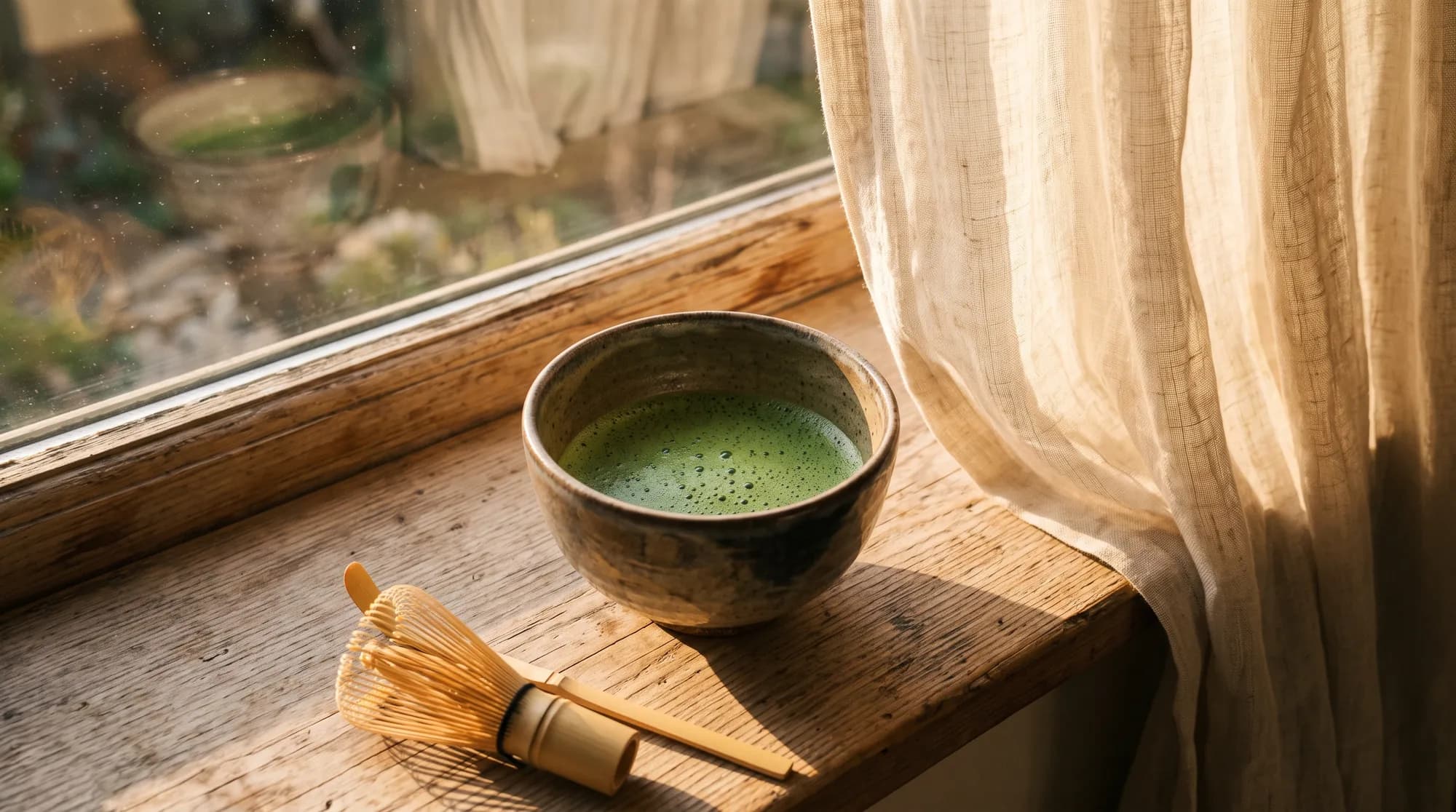
Matcha is often seen as a gentle drink, and that is partly true: a serving usually contains less caffeine than a cup of filter coffee. But it does contain caffeine, and a late bowl can affect your sleep. Let's look at how much caffeine is in a serving, how long it stays in the body, what sleep research shows and how to time your last bowl. This is general information, not medical advice.
How much caffeine is in a serving
The caffeine content of matcha depends on the grade and the batch. Analyses collected in the review by Kochman and colleagues (2020) found 19 to 44 mg of caffeine per gram of powder; another analysis found about 16 mg per gram (Koláčková et al., 2022). In a 2024 clinical trial, 2.7 g of matcha contained 71.5 mg of caffeine (Baba et al.). For a 2 g serving that is roughly 30–90 mg. The site uses the same range: 30–90 mg per serving.
For comparison, EFSA's guide figures are: an espresso (60 ml) about 80 mg, a cup of filter coffee (200 ml) about 90 mg, a cup of black tea (220 ml) about 50 mg, a can of cola (355 ml) about 40 mg, a can of energy drink (250 ml) about 80 mg and a bar of plain chocolate (50 g) about 25 mg.
How long caffeine stays in the body
The half-life is the time it takes for the amount of caffeine in the blood to fall by half. In adults, according to the review by Magkos and Kavouras (2005), it ranges from 2.5 to 10 hours. Much of this spread comes down to genetics: about 95% of caffeine is broken down by the liver enzyme CYP1A2, and its activity differs from person to person. Age, sex and hormones, smoking, diet, body weight, liver disease and some medicines also play a part (Nehlig, 2018).
A simple worked example. Say your half-life is 5 hours and you drink a bowl of matcha with 70 mg of caffeine at 4 pm. At 9 pm about 35 mg will still be in your body, and by 2 am about 17 mg. For someone with a slower metabolism the numbers will be higher.
What sleep research shows
In the study by Drake and colleagues (2013), participants took 400 mg of caffeine 0, 3 or 6 hours before their usual bedtime. Sleep was disrupted in all three cases compared with placebo, and even a dose 6 hours before bed noticeably reduced total sleep time. The authors supported the advice to avoid substantial caffeine for at least 6 hours before bed. They call this dose moderate, but in matcha terms it is large: about six servings by our guide figures.
A systematic review and meta-analysis of 24 studies (Gardiner et al., 2023) found that caffeine reduced total sleep time by 45 minutes on average and sleep efficiency by 7%. Falling asleep took about 9 minutes longer, time awake during the night grew by 12 minutes in total, and there was less deep sleep. By the authors' calculations, a coffee with 107 mg of caffeine should be drunk at least 8.8 hours before bed if it is not to shorten sleep.
In its safety assessment of caffeine, EFSA notes that even a single dose of 100 mg may affect sleep duration and patterns in some adults, especially when taken close to bedtime.
There is one study with matcha itself. 46 healthy adults aged 27–64 took 2.7 g of matcha in capsules (71.5 mg of caffeine and 50.3 mg of L-theanine) or a placebo every day for four weeks, no later than 2 hours before bed. Objective sleep measures by EEG did not differ between the groups (Baba et al., 2024). But this is one small study, the matcha was given in capsules, and the sponsor was a tea company. It doesn't override the general evidence on caffeine, and there is no reliable proof that L-theanine "cancels out" caffeine's effect on sleep.
How much caffeine a day is fine
According to EFSA (2015):
- For healthy adults, up to 400 mg of caffeine a day from all sources raises no safety concerns, and single doses of up to 200 mg.
- For pregnant and breastfeeding women the limit is 200 mg a day.
- For children and adolescents, safe amounts are worked out by body weight, about 3 mg per kilogram per dose.
One or two bowls of matcha a day, about 60–140 mg by our guide figure, fit within the limits for healthy adults with plenty of room to spare. But it is worth counting all your caffeine for the day: coffee, tea, cola, energy drinks and chocolate.
How to time your last bowl
- If you are sensitive to caffeine or sleep poorly, have your last bowl no later than early afternoon. For example, if you go to bed at 11 pm, the meta-analysis guide for a cup of coffee points to about 2 pm. A serving of matcha usually has less caffeine, so many people can drink it later, but it is best to test this on yourself.
- In the evening, if you want the ritual, make half a serving (1 g) or choose a caffeine-free drink.
- Watch yourself for a week or two: note when and how much you drank and how you slept. It will tell you more about your own sensitivity than any average.
- If you have insomnia, are pregnant, have heart rhythm problems or anxiety, or take medicines, talk to your doctor about caffeine.
Sources
- EFSA Panel on Dietetic Products, Nutrition and Allergies, 2015. Scientific Opinion on the safety of caffeine. EFSA Journal. DOI
- EFSA. Caffeine (topic page with conclusions and caffeine content of foods). efsa.europa.eu
- Magkos F., Kavouras S. A., 2005. Caffeine use in sports, pharmacokinetics in man, and cellular mechanisms of action. Critical Reviews in Food Science and Nutrition. PubMed
- Nehlig A., 2018. Interindividual Differences in Caffeine Metabolism and Factors Driving Caffeine Consumption. Pharmacological Reviews. PubMed
- Drake C. et al., 2013. Caffeine effects on sleep taken 0, 3, or 6 hours before going to bed. Journal of Clinical Sleep Medicine. PubMed
- Gardiner C. et al., 2023. The effect of caffeine on subsequent sleep: A systematic review and meta-analysis. Sleep Medicine Reviews. PubMed
- Baba Y. et al., 2024. Matcha Does Not Affect Electroencephalography during Sleep but May Enhance Mental Well-Being: A Randomized Placebo-Controlled Clinical Trial. Nutrients. PubMed
- Kochman J. et al., 2020. Health Benefits and Chemical Composition of Matcha Green Tea: A Review. Molecules. PubMed
- Koláčková T. et al., 2022. The Effect of In Vitro Digestion on Matcha Tea (Camellia sinensis) Active Components and Antioxidant Activity. Antioxidants. PubMed