
October 22, 2026
L-theanine and Caffeine in Matcha: What the Research Shows
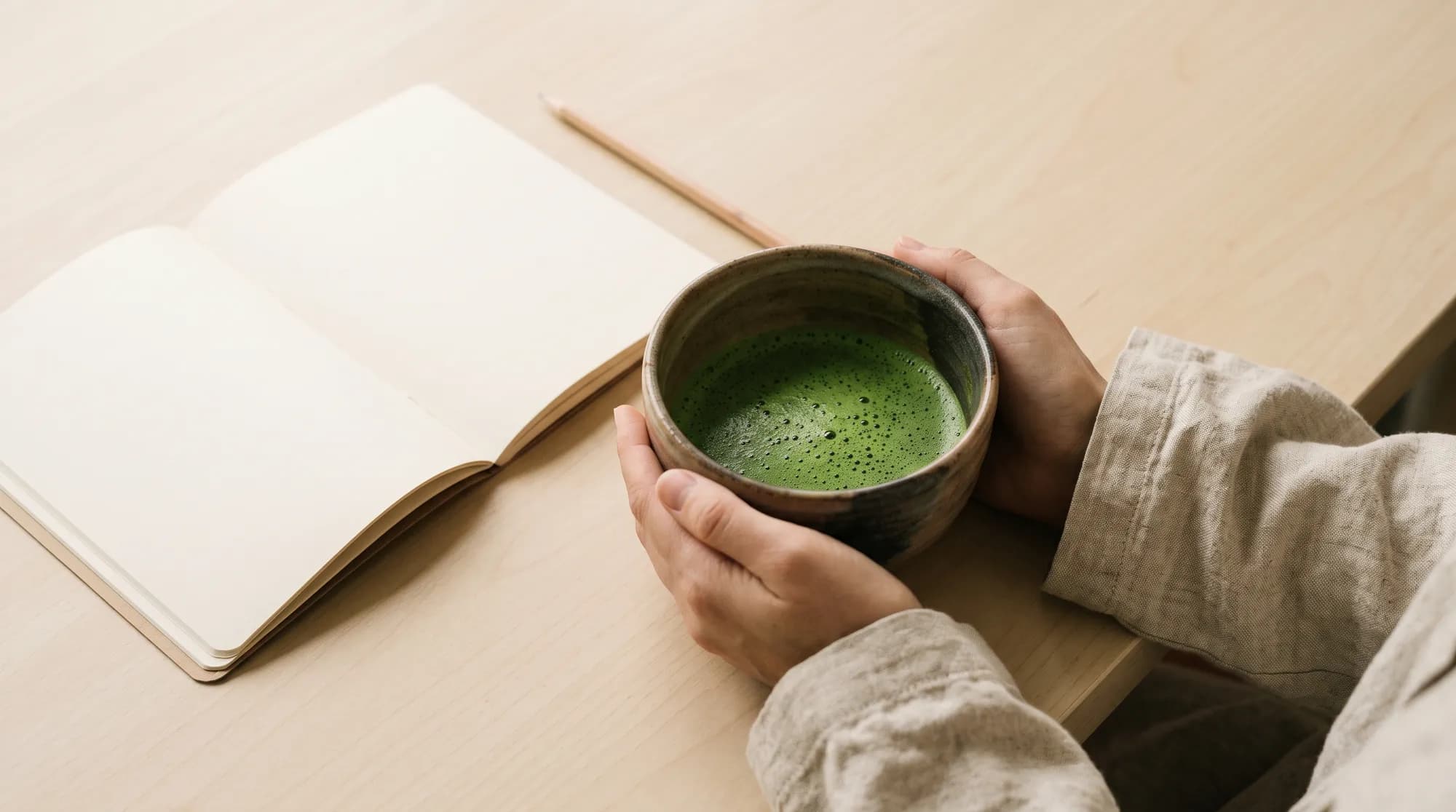
People often say matcha gives a calmer lift than coffee and put it down to L-theanine. There is some truth in that, but the research paints a more modest and cautious picture. Let's look at what L-theanine is, how much of it is in a bowl, what scientists actually found and where the limits of that evidence lie.
What L-theanine is
L-theanine is an amino acid found naturally in tea. Coffee doesn't contain it. It is L-theanine, together with caffeine, that people usually have in mind when they talk about the "calm alertness" of tea.
How much of it there is depends on how the tea was grown. When the bushes are shaded before harvest, the leaves accumulate more L-theanine, caffeine and chlorophyll (Kochman et al., 2020). That is why shaded teas such as gyokuro and matcha are high in L-theanine. Even so, as the authors of a review of Japanese green teas stress (Unno et al., 2026), the amount varies considerably with the harvest season, the tea cultivar and the way it is grown.
How much is in a bowl of matcha
With brewed tea, only what passes into the water ends up in your cup, and the leaf stays in the pot. With matcha you drink the leaf itself and get everything in it.
The actual figures vary widely. One analysis found about 10 mg of L-theanine per gram of matcha powder (Koláčková et al., 2022). In a 2024 clinical trial, 2.7 g of matcha contained 50.3 mg of L-theanine and 71.5 mg of caffeine (Baba et al.). For a normal 2 g serving that is roughly 20–40 mg of L-theanine. Keep this number in mind: in the studies described below the dose was almost always higher.
How these studies work
Typically, volunteers receive caffeine, L-theanine, both, or a placebo on different days without knowing which. They then do computer tests of attention, memory and reaction speed and rate how they feel on standard scales: how alert, calm or tired they are. The effect is measured in the first hour or two after taking the dose.
What was found
In the study by Haskell and colleagues (2008), participants took 250 mg of L-theanine and 150 mg of caffeine separately and together. Caffeine sped up reactions, improved accuracy on an attention task and reduced the feeling of mental fatigue. The combination brought further improvements in several more tests, reduced ratings of tiredness and headache and increased alertness. L-theanine on its own, however, slightly increased headache ratings in this study and worsened performance on a counting task.
In the study by Owen and colleagues (2008), 27 people took 50 mg of caffeine with or without 100 mg of L-theanine. With L-theanine added, participants switched attention between tasks faster and more accurately and were less distracted in a memory task.
Giesbrecht and colleagues (2010) gave 44 young adults 97 mg of L-theanine with 40 mg of caffeine. Compared with placebo, accuracy in task switching and self-rated alertness improved and tiredness decreased. The combination had no effect on other tests, such as visual search, choice reaction time and mental rotation.
A systematic review and meta-analysis of 11 such studies (Camfield et al., 2014) found a moderate effect of caffeine plus L-theanine on alertness and attention-switching accuracy in the first two hours. An interesting detail: the size of the effect depended more on the caffeine dose than on the L-theanine dose.
What about matcha itself
There are fewer studies with matcha itself. In one, 42 people aged 25–34 took 2 g of matcha or a placebo every day for two weeks. After a mild stress task, reaction time on an attention test was lower in the matcha group than in the placebo group, and the other tests showed no difference (Baba et al., 2021). In another study by the same group, with middle-aged and older adults, the authors concluded that under stress matcha supported attention and work performance better than caffeine alone (Baba et al., 2021).
The review by Sokary and colleagues (2023) draws a cautious conclusion: in clinical trials matcha reduced stress, slightly improved attention and memory and had no effect on mood, but the findings on cognitive function are contradictory and more trials are needed.
The limits of the evidence
- Small samples: 27, 42, 44 people.
- Short time frames. Effects were usually measured over a few hours after the dose, less often after several weeks.
- Doses. The studies used 97–250 mg of L-theanine, while a serving of matcha contains roughly 20–40 mg.
- Comparisons. The combination was often compared with a placebo rather than with the same amount of caffeine alone. Then it is impossible to say how much of the effect came from L-theanine.
- Funding. Some of the work was done by researchers at large tea companies. That doesn't make the results wrong, but it is worth knowing.
- Laboratory tests are not the same as an ordinary working day.
What this means in practice
A bowl of matcha is a moderate dose of caffeine together with a small amount of L-theanine. The research allows that this combination may help you stay focused on a demanding task, but the effect is moderate and owes more to the caffeine. The calm alertness that many matcha drinkers describe may well be real, but the science doesn't yet allow us to promise it to everyone.
- Don't expect miracles: matcha won't replace sleep and rest.
- If you are sensitive to caffeine, remember that matcha contains it, and L-theanine doesn't change that. Our article on caffeine and sleep covers when to have your last bowl.
- L-theanine supplements are a separate topic. If you are thinking of taking them, talk to your doctor.
Sources
- Haskell C. F. et al., 2008. The effects of L-theanine, caffeine and their combination on cognition and mood. Biological Psychology. PubMed
- Owen G. N. et al., 2008. The combined effects of L-theanine and caffeine on cognitive performance and mood. Nutritional Neuroscience. PubMed
- Giesbrecht T. et al., 2010. The combination of L-theanine and caffeine improves cognitive performance and increases subjective alertness. Nutritional Neuroscience. PubMed
- Camfield D. A. et al., 2014. Acute effects of tea constituents L-theanine, caffeine, and epigallocatechin gallate on cognitive function and mood: a systematic review and meta-analysis. Nutrition Reviews. PubMed
- Baba Y. et al., 2021. Matcha consumption maintains attentional function following a mild acute psychological stress without affecting a feeling of fatigue: A randomized placebo-controlled study in young adults. Nutrition Research. PubMed
- Baba Y. et al., 2021. Effects of Daily Matcha and Caffeine Intake on Mild Acute Psychological Stress-Related Cognitive Function in Middle-Aged and Older Adults: A Randomized Placebo-Controlled Study. Nutrients. PubMed
- Baba Y. et al., 2024. Matcha Does Not Affect Electroencephalography during Sleep but May Enhance Mental Well-Being: A Randomized Placebo-Controlled Clinical Trial. Nutrients. PubMed
- Sokary S. et al., 2023. The therapeutic potential of matcha tea: A critical review on human and animal studies. Current Research in Food Science. PubMed
- Kochman J. et al., 2020. Health Benefits and Chemical Composition of Matcha Green Tea: A Review. Molecules. PubMed
- Koláčková T. et al., 2022. The Effect of In Vitro Digestion on Matcha Tea (Camellia sinensis) Active Components and Antioxidant Activity. Antioxidants. PubMed
- Unno K. et al., 2026. Compositional Diversity and Functional Interactions of Bioactive Compounds in Japanese Green Tea: Focus on Matcha, Sencha, and Gyokuro. Molecules. PubMed