
October 22, 2026
How to Store Matcha So It Stays Fresh Longer
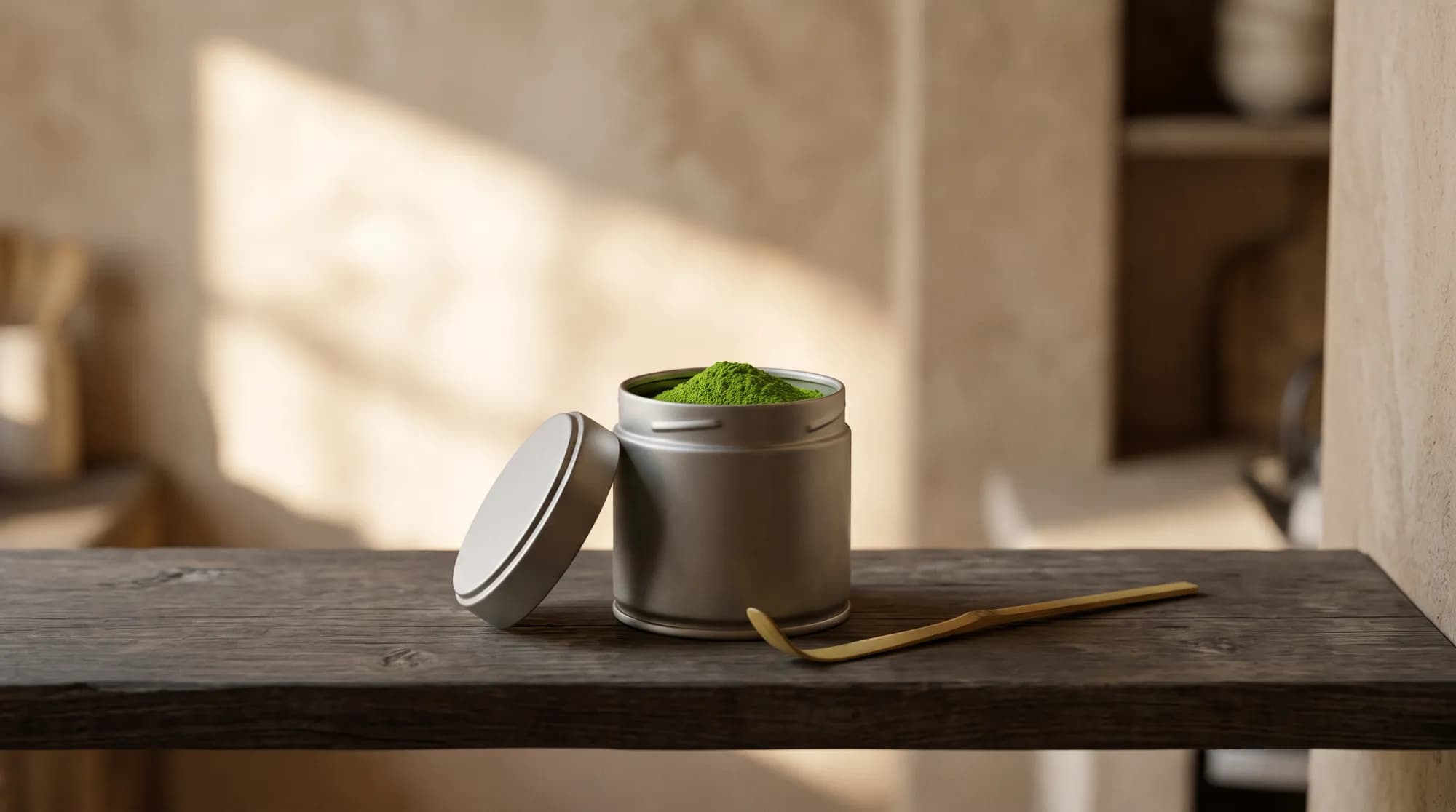
Matcha is a very fine powder, and its particles have a huge combined surface area. That is why heat, light, moisture and air affect it faster than they affect leaf tea, and even good matcha stored badly can lose much of its colour and taste within a few weeks. The good news is that the rules are simple and need nothing special.
What spoils matcha
Heat. In a laboratory study by Kim and colleagues (2020), matcha was stored for two months at temperatures from 4 to 80 °C. The higher the temperature and the longer the storage, the more the green colour faded and the fewer catechins remained, including EGCG, along with other polyphenols and even caffeine. Antioxidant activity fell too. At 4 °C, roughly fridge temperature, EGCG content stayed stable for the full two months.
Light and humidity. In a 2026 study by the same group, matcha was stored at different humidity levels, either in the dark or under ordinary laboratory LED lighting (Kim et al., 2026). Polyphenols and antioxidant activity declined fastest at high humidity and in the light. Under light, the amount of EGCG and ECG halved in about 30–40 days. The compounds kept best in dry conditions and in the dark.
Air and odours. The less the powder is exposed to air, the longer it stays fresh. Matcha also picks up other smells easily, so it is better not to keep it next to spices, coffee or anything with a strong aroma.
How to store it
- Use an opaque container with a tight lid. If your matcha comes in a resealable bag, press the air out before closing it and put the bag in a tin.
- Choose a cool, dry, dark place away from the stove, kettle, oven and window.
- Once opened, keep matcha in the fridge in a tightly closed container.
- Before opening a cold container, let it stand at room temperature until it no longer feels cold. Otherwise moisture from the air will condense on the cold powder, and humidity, as the studies show, is one of the main threats.
- Take out as much as you need for one bowl and close the container straight away. Don't open it over steam from the kettle.
- Use only a dry scoop. A damp chashaku carries water inside.
- Buy as much as you can finish in a month or two. A big stock only pays off if you really get through it.
If you don't drink matcha often
Every time you open the container, fresh air gets in, and if it comes from the fridge there is a risk of condensation. If one pack lasts you a long time, divide the matcha into two or three small airtight jars as soon as you buy it. Open them one at a time and keep the rest closed in the fridge. That way most of the powder meets air and moisture far less often.
Fridge or freezer
For opened matcha the fridge is enough. In the study by Kim and colleagues (2020), catechins kept best at 4 °C. The freezer only makes sense for unopened packs that you don't plan to open for the next few weeks. Let such a pack warm up fully to room temperature before opening it, and don't refreeze opened matcha: every swing in temperature raises the risk of moisture getting in.
How long opened matcha keeps
After opening, it is best to use matcha within about 1–2 months, and its colour and taste are at their brightest in the first 4–6 weeks. This is a practical guide, not a strict limit: a lot depends on how you store it. For an unopened pack, go by the best-before date given by the producer.
How to tell matcha is past its best
- The colour has turned dull, olive or yellowish.
- The aroma is faint, or it smells of hay.
- The taste is more bitter and flatter, and the sweetness has gone.
- It whisks into foam less easily than before.
You don't have to throw such matcha away. If the powder is dry, free of moisture clumps and odd smells, and within its best-before date, you can use it for lattes or baking, where the difference is hardly noticeable.
Clumps: normal or a warning sign
Small, soft clumps in matcha are normal. Fine powder compacts on its own, especially in the fridge, and that is exactly why matcha is sifted before use. If the clumps break up easily in the sieve, all is well.
Be wary if the lumps are hard and feel damp, the powder has caked into a solid layer, there is a sour or musty smell, or you can see spots of mould. Such matcha is best not used at all, not even for baking.
Summer in Tashkent
In summer, flats in Tashkent get very hot, and a cupboard next to the stove can turn out to be the warmest spot in the kitchen. In the hot months the fridge matters even more, including for unopened packs if you have bought matcha in advance. And don't leave matcha in a car in the sun: even a few hours of heat do it no good.
Sources
- Kim J. M. et al., 2020. Effect of storage temperature on the antioxidant activity and catechins stability of Matcha (Camellia sinensis). Food Science and Biotechnology. PubMed
- Kim J. M. et al., 2026. Effect of water activity and light exposure on the stability of bioactive compounds in matcha (Camellia sinensis) powder during storage periods. Food Chemistry. PubMed