
October 22, 2026
Ceremonial vs Culinary Matcha: The Difference and How to Choose
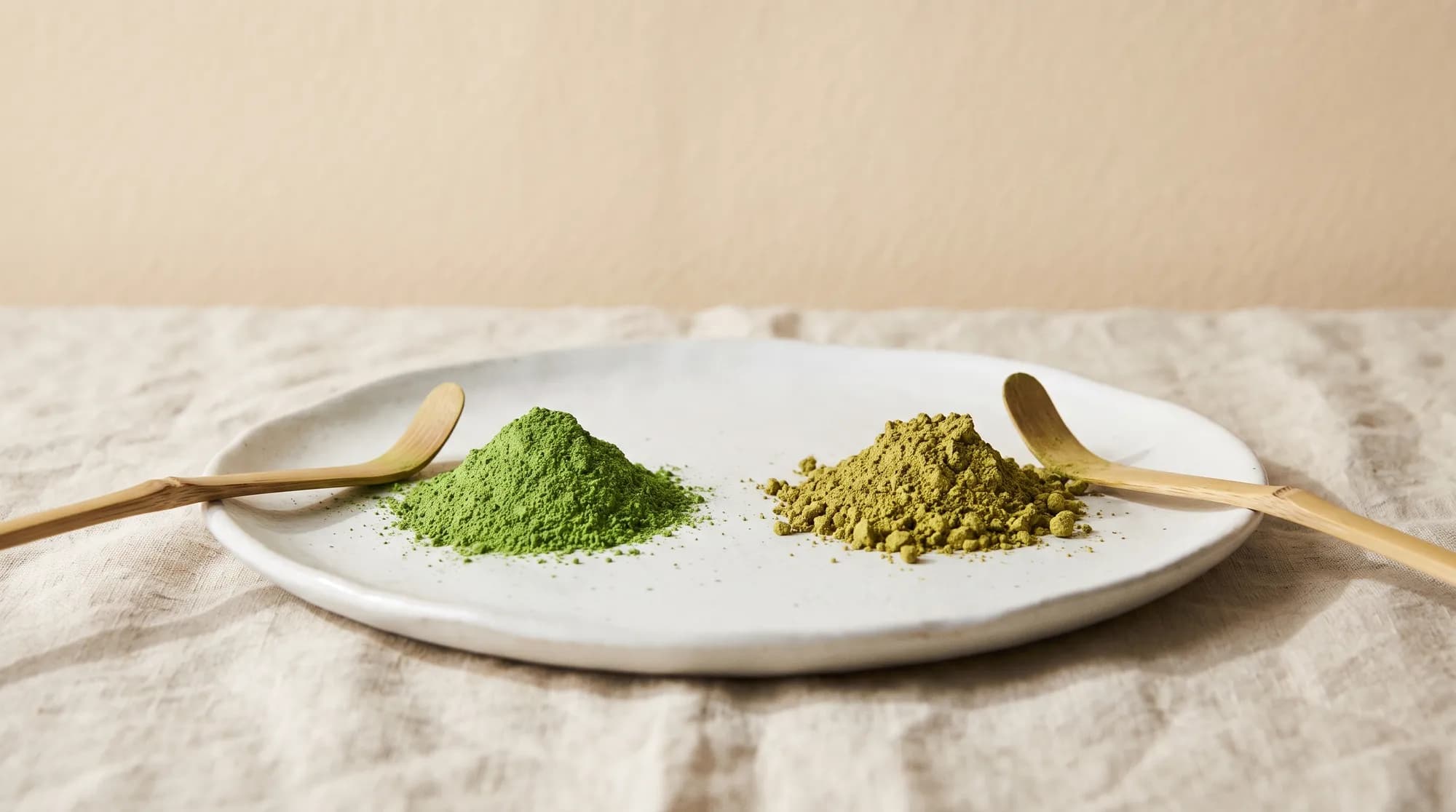
Matcha packs carry words like "ceremonial", "premium" and "culinary". They help you get your bearings, but they are not strict categories: each producer draws the line between grades in its own way. Below we look at how the grades really differ, how to judge a powder yourself and which matcha to use for a bowl with water, for a latte and for baking.
Why matcha varies so much
The authors of a review of Japanese green teas (Unno et al., 2026) say plainly that matcha on the market varies widely in quality, from high-grade ceremonial products to simple powders. Its composition depends on the harvest time, the tea cultivar, the way it is grown and how young the leaves were.
This shows up in laboratory analyses too. Italian researchers compared three matcha grades, from top ceremonial to culinary (Toniolo et al., 2025). The simpler the grade, the fewer amino acids and less caffeine it contained, and the more polyphenols. The authors link this mainly to harvest time and leaf maturity. In another study, cheaper culinary matcha contained more phenolic compounds than ceremonial matcha (Meyer et al., 2023).
The key point: culinary matcha is not "bad", it is different. It has a more astringent, slightly bitter taste that works well in recipes but seems harsh in a plain bowl with water.
The main grades
- Ceremonial. For the classic bowl with water. Bright green colour, a mild taste with umami notes, almost no bitterness. The most expensive.
- Premium, or everyday matcha. For drinking and lattes: the colour is a little less bright, the taste is good but simpler.
- Culinary. For baking, desserts and smoothies. The taste is more astringent and bitter so that it isn't lost among other ingredients. Noticeably cheaper.
How to judge matcha yourself
- Colour. Fresh, good-quality matcha is bright, vivid green. A yellowish, olive or brownish tint points to a simpler grade or to powder that was kept warm or in the light. In laboratory tests, matcha's green colour faded more the higher the temperature and the longer the storage (Kim et al., 2020).
- Aroma. Fresh and grassy, with sweetish notes. A smell of hay, dust or mustiness is a bad sign.
- Texture. A very fine, silky powder, like talc. If you rub a pinch between your fingers, it leaves a smooth green trace. Grains and grit point to a coarse grind.
- Taste. Try it in a plain bowl with water at the standard proportion: 2 g of matcha to 70 ml of water at 80 °C. Good ceremonial matcha is pleasant without sugar. If the bitterness is strong, the powder is better used for lattes or baking.
- Foam. Fresh matcha usually whisks easily into a fine, dense foam. If the foam won't hold even with the right technique, the powder may be old or badly stored.
Common misconceptions
"Ceremonial means healthiest." Not necessarily. As the analyses above show, simpler grades can even contain more polyphenols. Ceremonial matcha differs mainly in taste, colour and amino acid content, not in "benefits".
"The greener, the better." It is a good guide to freshness, but colour in photos and under different lighting can mislead. Judge the powder in daylight and compare it with what you have tried before.
"You can't drink culinary matcha." You can, especially with milk: it is just more astringent and bitter. In a plain bowl with water, though, its taste usually seems harsh.
Work out the price per serving
To compare packs of different sizes, look at the price of one serving. Divide the price by the weight in grams and multiply by 2. For example, our matcha costs 215,000 UZS for 60 g: that is about 3,600 UZS per gram and about 7,200 UZS per 2 g serving.
Baking and desserts usually take more matcha than a single bowl, and its delicate taste gets lost among sugar, butter and flour anyway. So for cooking it makes sense to buy a more affordable grade and keep ceremonial matcha for the bowl.
Which matcha for what
- A bowl with water (usucha), and especially thick koicha: ceremonial only.
- Lattes and iced drinks: ceremonial or premium both work. Ceremonial gives a cleaner, brighter taste, but milk and sugar narrow the gap.
- Smoothies, baking, creams, ice cream: culinary. Heat and rich, sweet ingredients wash out the subtle notes of ceremonial matcha anyway.
What to check on the pack
- Country of origin. It should be stated clearly. For our matcha it is Japan.
- Ingredients. Pure matcha has one ingredient: ground green tea. If the list includes sugar, milk powder or flavourings, it is a drink mix, not pure matcha.
- Weight, production date and best-before date.
- Packaging. Opaque and tightly sealing: matcha doesn't like light, heat, moisture or air.
- What the grade is for. It helps when the producer says plainly whether the powder is meant for drinking or for cooking.
A word about our matcha
We sell ceremonial matcha from Japan. It is meant for the classic bowl with water, and in a latte it gives a bright taste. If you'd like to check it yourself, make a bowl at the standard proportion and judge it by the signs described above.
Sources
- Unno K. et al., 2026. Compositional Diversity and Functional Interactions of Bioactive Compounds in Japanese Green Tea: Focus on Matcha, Sencha, and Gyokuro. Molecules. PubMed
- Toniolo C. et al., 2025. A Comparative Multianalytical Approach to the Characterization of Different Grades of Matcha Tea (Camellia sinensis (L.) Kuntze). Plants. PubMed
- Meyer B. R. et al., 2023. Catechin Composition, Phenolic Content, and Antioxidant Properties of Commercially-Available Bagged, Gunpowder, and Matcha Green Teas. Plant Foods for Human Nutrition. PubMed
- Kim J. M. et al., 2020. Effect of storage temperature on the antioxidant activity and catechins stability of Matcha (Camellia sinensis). Food Science and Biotechnology. PubMed